
“Let’s talk about what cannot be seen.”
As a good friend of mine says, “Public lighting is an orphan.” Nobody remembers it until the streetlight above our heads is off and fails to illuminate—or, worse, when a tragedy occurs. It is at that moment when concern begins for what we see, but the real question is: what happens, and who cares about what we do NOT SEE in public lighting?
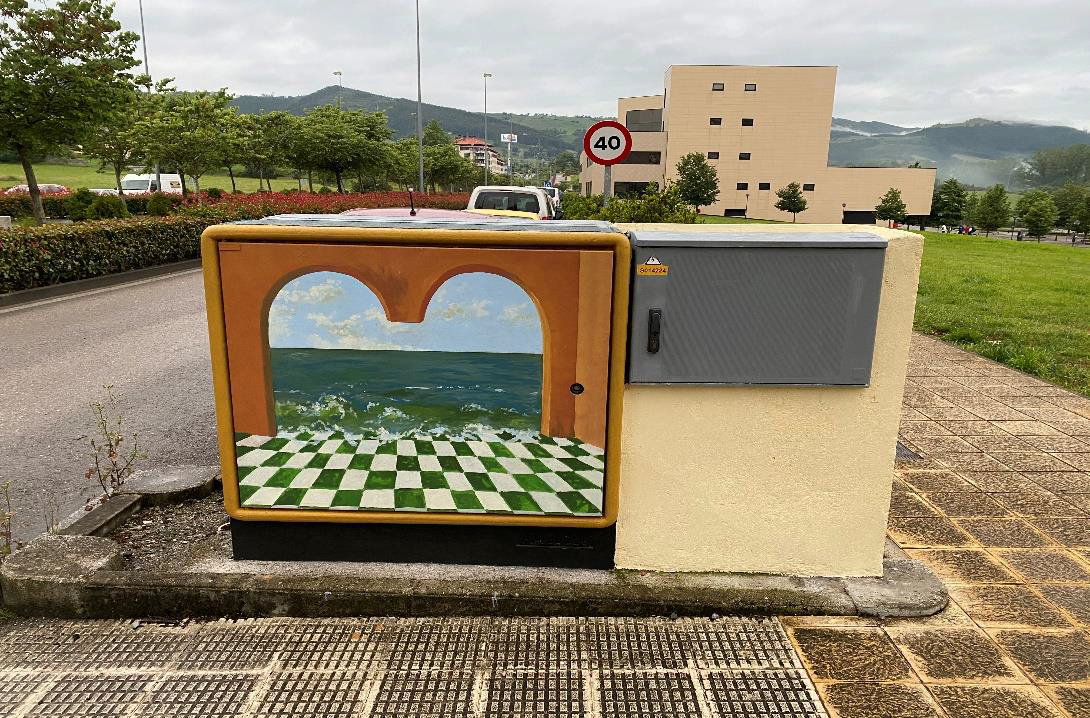
(Public lighting cabinet near the Polytechnic School of Mining and Energy Engineering in Torrelavega, Cantabria.)
The strong activity in the sector indicates that the market is already mature. The subsidies from IDAE through FEDER funds, and the twenty or so ESE projects currently being undertaken in this legislative period, clearly show that public lighting, for many city councils, has become a tangible reality rather than just a political goal—without even considering the relief that the economic savings provide to struggling municipal budgets, or the great nighttime visual comfort in our towns and cities.
The media echo numerous articles about the importance of light pollution. No one doubts that we are in an alarming situation, and that this is a factor to take into account when designing the lighting projects of our cities. At EnergyTAS, we work to the maximum to ensure sustainability and minimize light pollution, but without losing sight of the true need of our lighting systems: to provide good illumination and to be safe.

We also find articles referring to the requirements demanded of LED luminaires. It is worth highlighting the great effort made by the Spanish Lighting Committee (Comité Español de Iluminación), which has achieved a valuable tool that allows engineering firms to design lighting projects without depending on any manufacturer, thereby maintaining our independence(1).
These publications underscore the importance of such requirements and help us eliminate from the market those undesirable projects using luminaires of highly questionable quality that have tarnished our professional work.
There are no shortage of articles showcasing lighting projects that include color changes in certain urban areas, or that employ different optical technologies to achieve better results, as well as hundreds of reports from manufacturers proudly displaying excellent lighting projects.
What personally worries and alarms me is how little is said about SAFETY—and yes, I write it in capital letters. This is not only about road safety regarding the use of light—where even Google(2) has had to include in its app an option to choose which areas of the city are safe to walk through at night because they have more light, which is incredible—but about TOTAL SAFETY IN PUBLIC LIGHTING.
After more than 20 years of experience in the public lighting sector, it is now, in this legislative period, that I notice in each of my presentations to city councils that the market is completely mature and that LED lighting has come to stay. But my question is: WHAT ABOUT THE SAFETY THAT CANNOT BE SEEN?

More than 40% of the lighting control panels audited daily by our field teams are in a totally precarious condition and show a high degree of obsolescence, implying a clear lack of safety that seems to be of little importance.
We find elements as old as the lighting systems themselves — as in the recent image on the left from a town in northern Spain — where the cabinet still contains old fire-ampoules.
I invite all municipal technicians with competence in the matter, as well as the political representatives responsible for their municipalities, to spend an hour browsing the internet and searching for news about electrical failures in public lighting. Some will throw their hands up and say, “Ours is just like that.”
Articles such as the one published in ABC(3) reported the death of a poor animal that went out to the park with its owner and, when urinating on a streetlight, was electrocuted — leading to the condemnation of the City Council of Pobla de Farls to pay €7,585.
I am sure that many of you, when speaking with municipal technicians, councilors, or mayors, have heard about the problems caused by dogs urinating at the base of streetlights. The complaint is almost always about cleanliness or aesthetics, but rarely, if ever, about the danger this poses to the installation — and, consequently, to the residents.
It doesn’t stop with animals — there have also been human deaths, such as the one I had the misfortune of personally witnessing in the case of the girl from Santiago de Compostela, who was electrocuted while playing one festive night due to a lack of safety protections. Some of the headlines were chilling. Perhaps the most striking was the report by VOZPOPULI, because it exposed the harsh reality of a problem present throughout Spain: “A girl dies in Santiago, electrocuted after leaning on a lamppost.” Terrifying.
In the sector, everyone remembers this incident, and it must remain in our minds whenever we undertake a new project. This tragedy should never, under any circumstances, happen again.
Here, I would like to point out — for public employees who may read these reflections — that the case ended with the indictment of the municipal technician of Santiago de Compostela, as cited in the attached article(4), where the forensic police reported the absence of grounding in the luminaire. The question is: Was no one aware of this fact?
Almost half of the thousands of public lighting panels analyzed by my colleagues in recent years are in It is allowed for anyone to access and manipulate a lighting control cabinet, to use it for anything — not just to power our lighting systems.
Two years in prison was the sentence given to an electrician who worked for a town council in the Balearic Islands, as reported in the news(5). In that case, some fairground workers connected their caravan to a lighting installation that the council had provided through its electrician — resulting in the death of one of them on a very rainy day.
How were the protections? Why was a lighting cabinet — whose sole purpose should be to supply power to public lighting — allowed to be used for other purposes?
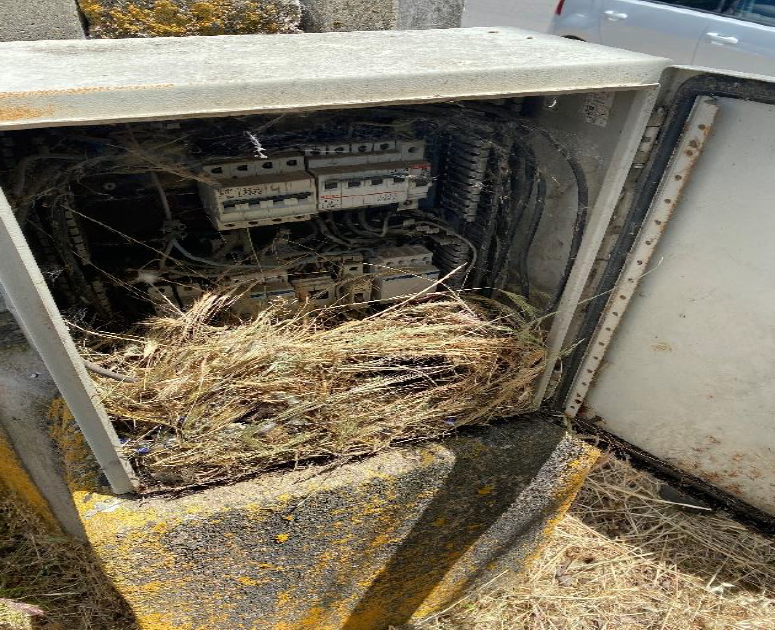
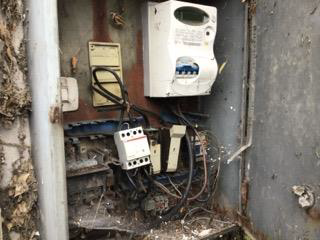
Lighting cabinets where birds build their nests and rodents take shelter from the rain without paying any municipal tax.
In the hundreds of audits I have carried out in different municipalities throughout Spain, the lack of safety has been clearly demonstrated, and many technicians admit they are aware of it.
It is even worse in small municipalities that don’t even have a municipal technician. In those cases, the councilor or mayor often acts as the lighting technician without realizing the importance of their actions or the consequences that may follow.
“The court ruled that the municipal employee in charge of the town’s electrical installations knew and was aware that the lamppost in question was delivering electric shocks and was in poor condition. Despite this, **no measures were taken to prevent or eliminate the electrical discharges.”(6)
For the technicians reading this article: the judge’s verdict was the acquittal of the mayor and the conviction of the municipal technician to two years in prison. Inaction leads to these outcomes.
In the same report, it is stated that industry personnel conducted an inspection and confirmed the following:
“Two engineers from the Department of Industry who inspected the public lighting in Bunyola after the accident testified in court that all the lampposts along the promenade where the incident occurred were unprotected due to a faulty main electrical cabinet. One of the expert technicians explained that the installation from which the current originated caused ‘all the lampposts connected to that cabinet to be unprotected…’”
I would like to emphasize that it is not only the poor condition of the control panels — it also extends to the electrical lines and the protections within the luminaires themselves.
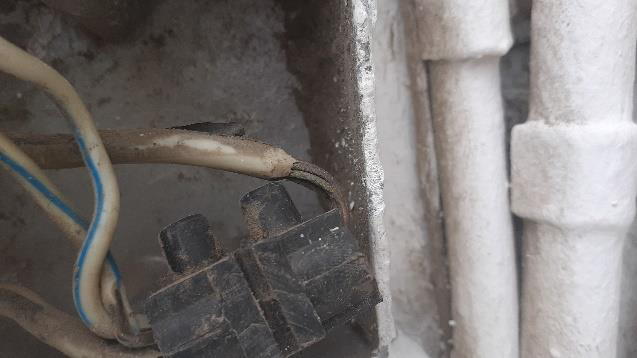
In our daily field operations, we detect numerous non-compliant splices inside luminaires, splices directly on the line using electrical tape — color-coded, of course, so as not to lose track of the phase — and a long list of other issues that I dare say are shameful and unprofessional.
I have thousands of photos and videos of public lighting cabinets in deplorable condition:
places where rodents live openly, where a bird builds its nest — even raising chicks for months —, and photos showing lizards that have been electrocuted after entering through the cabinet protections.
Videos reveal cabinets tied shut with ropes or any kind of improvised fastening, obviously non-certified.
All of this leads us to a single conclusion:
maintenance plans simply do not exist, and all actions taken are corrective rather than preventive, leading to the consequences described in the previously cited articles.
I hope this note serves as a reflection.
Of course, what is visible matters, just as road safety does — but in many cases, what is unseen is even more important.
Lighting levels must be well defined and controlled, but “before installing a luminaire, one must ensure the safety of the cabinets and their protections.”
Only then can we avoid liability — or worse, tragedies.
It is not only people and animals who die; I am sure that the technicians involved in the incidents described above have also died inside, regretting not having acted sooner.
Projects must be comprehensive:
they must begin with the lighting cabinet, continue through the installation and the luminaire, and end with the light itself.
Each of these elements must be analyzed and certified in accordance with current legislation.
If there is not enough funding for a project of this scope, the lighting network should be divided by cabinet, and work should proceed cabinet by cabinet as a first step.
Those subsidies intended exclusively for the purchase of LED lamps should have a prerequisite: safety.
It is not simply a matter of changing bulbs — that’s bread for today and hunger for tomorrow.
Without addressing safety first, I would dare say that the promised energy savings are not even achieved in these types of projects.
We should not wait for a judge to seal off an installation(7).
If there is a lack of safety, the first step must be to resolve it, and if that means temporarily shutting down the public lighting system, then it should be explained to the residents and resolved immediately.
Municipal technicians, councilors in charge of public works, and mayors who care about public lighting:
request lighting safety projects.
Do not limit your term in office to being the ones who merely changed the old lampposts for LEDs.
Aspire to be remembered as those who carried out a comprehensive reform of your town’s lighting system — one where safety, efficiency, and sustainability come first.
Carlos Cifuentes G.
1 https://www.ceisp.com/el-cei/biblioteca/idae/
2 https://www.xda-developers.com/google-maps-prepares-lighting-layer-highlight-brightly-lit-streets-night-travel/
3 https://www.abc.es/espana/comunidad-valenciana/abci-condenan-ayuntamiento-muerte-perro-electrocutado-tocar-farola-201902221657_noticia.html)
4 https://www.lavozdegalicia.es/noticia/santiago/santiago/2017/01/15/imputado-tecnico-municipal-nina-electrocutada-vite/0003_201701S15C1994.htm
5 https://www.diariodeibiza.es/pitiuses-balears/2015/03/27/anos-prision-electricista-muerte-feriante/758009.html
6 https://www.prevencionintegral.com/actualidad/noticias/2017/07/25/absuelven-alcalde-condenan-electricista-municipal-por-muerte-joven-electrocutado-con-farola